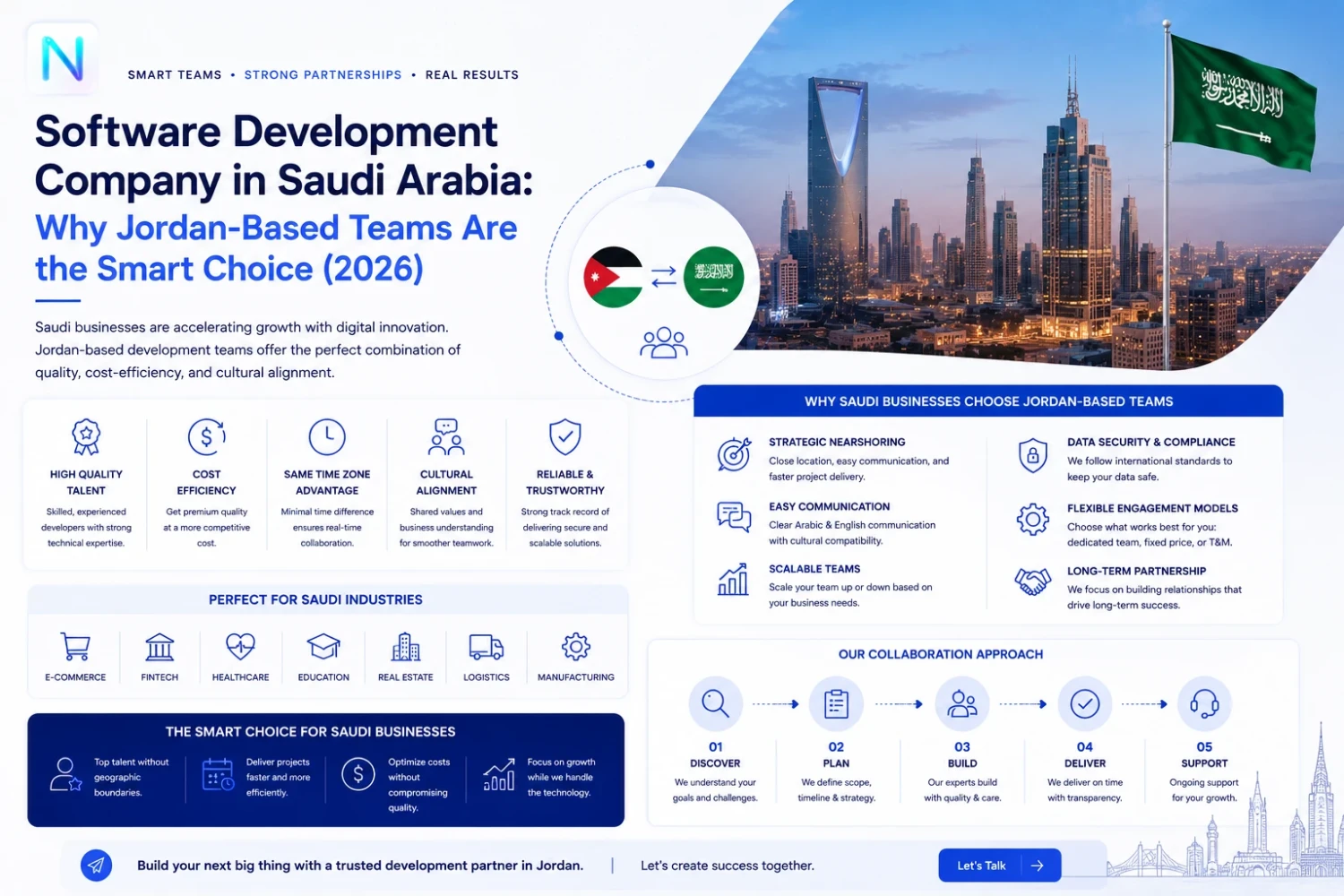
Saudi Arabia is in the middle of the most ambitious digital transformation program in the region's history. Vision 2030 has pushed billions of riyals into banking modernization, e-government platforms, retail technology, logistics automation, and healthcare digitization. Every ministry, bank, and enterprise in the Kingdom is racing to build or upgrade software — and that demand has created a serious talent bottleneck.
If you've searched for a "software development company in Saudi Arabia," you've likely run into one of two problems: local Riyadh and Jeddah agencies charging premium rates with long waitlists, or distant offshore vendors in South Asia or Eastern Europe who come with communication gaps, timezone friction, and little understanding of GCC business or regulatory context.
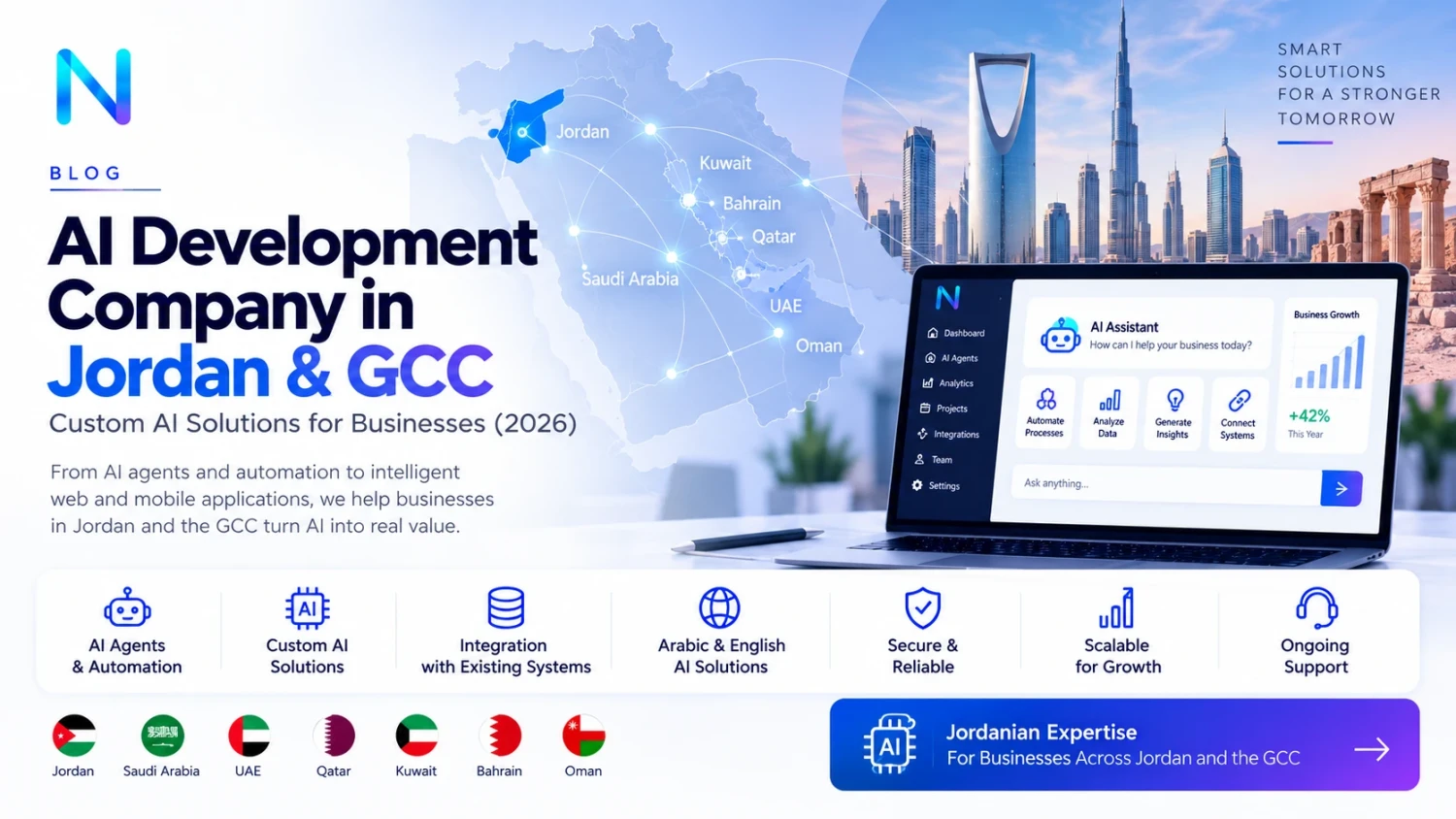
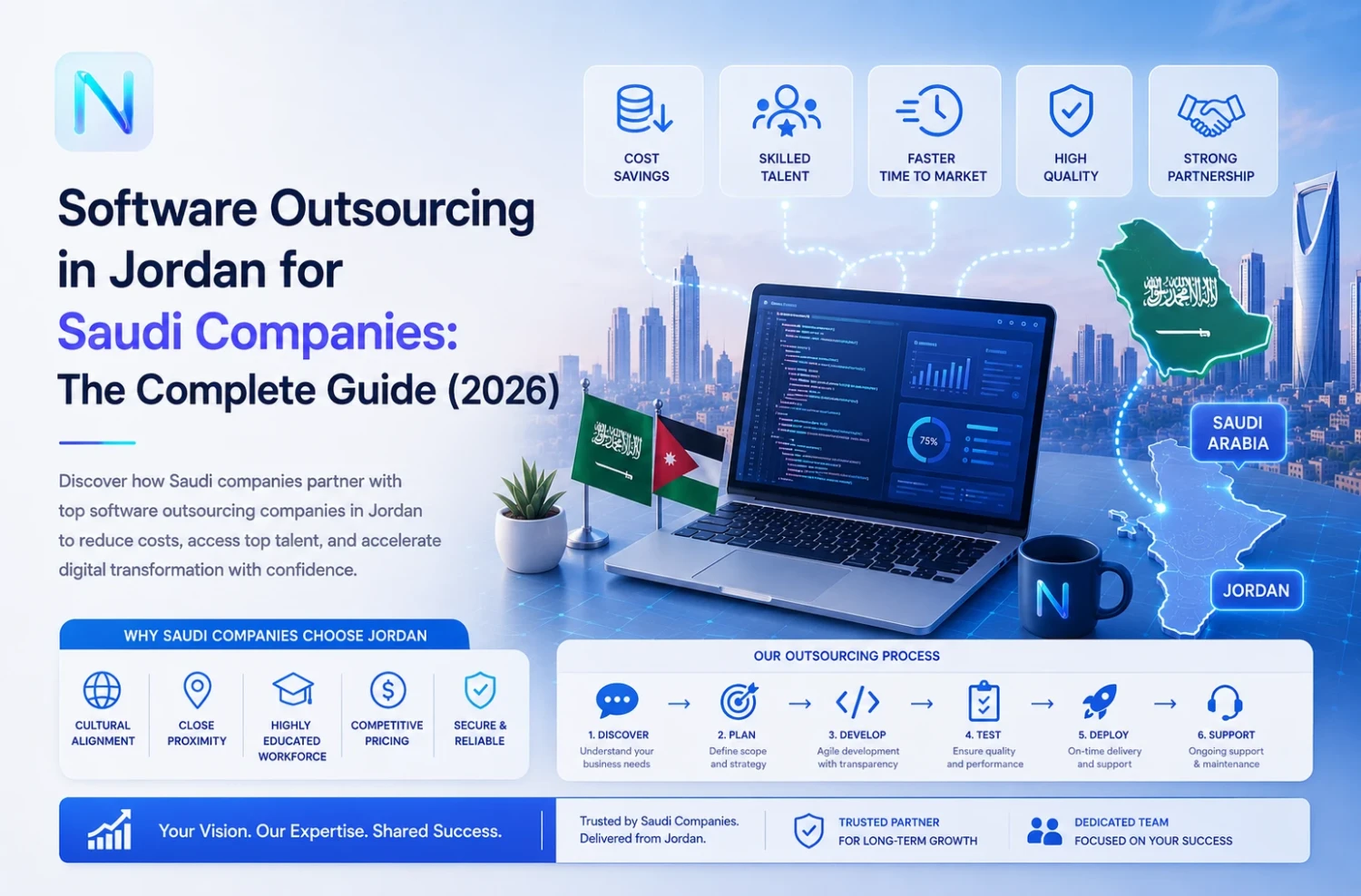
There's a third option that more Saudi businesses are quietly choosing every year: partnering with a software development company based in Jordan.
The Saudi Software Talent Gap, By the Numbers
Saudi Arabia's IT sector has grown faster than its local talent pipeline. Demand for software engineers, especially senior full-stack developers, DevOps engineers, and mobile specialists, consistently outpaces domestic supply. This has pushed local day rates higher and extended hiring timelines for in-house teams to months. For companies that can't wait, or can't justify the cost of building an in-house engineering team from scratch, outsourcing has become the default strategy — the only real question is where.
Why Jordan Has Become the GCC's Nearshore Development Hub
Amman has spent the last decade building a genuine tech ecosystem: strong computer science programs at the University of Jordan, JUST, and Princess Sumaya University for Technology; a growing base of startups and outsourcing firms; and a generation of engineers fluent in both Arabic and English. Unlike offshore hubs that serve global clients generically, Jordan-based firms have built their businesses specifically around GCC clients — which changes how they work.
1. Same Time Zone, Real-Time Collaboration
Jordan sits in the same time zone as Saudi Arabia (UTC+3), or within one hour depending on daylight saving adjustments. That means your Jordan-based development team is online during your business hours — not asleep during your morning standup. Daily syncs, live demos, and same-day bug fixes are the norm, not the exception. Compare that to outsourcing to India or the Philippines, where a 3-6 hour gap routinely turns same-day issues into 24-48 hour turnarounds.
2. Meaningful Cost Savings Without Cutting Corners
Software development rates in Jordan typically run 30-50% lower than equivalent local hiring or development in Riyadh and Jeddah, while still meeting the quality bar international clients expect. This isn't a race-to-the-bottom savings — Jordanian firms serving GCC markets have to meet the same standards as local vendors, because their business depends entirely on repeat GCC contracts. The savings come from lower operating costs in Amman, not from cutting corners on senior talent or QA.
3. Arabic-English Bilingual Teams
Miscommunication is the single biggest reason outsourced software projects fail — vague requirements, lost context, requirements re-explained three times across a language barrier. Jordanian development teams typically work fluently in both Arabic and English, meaning your stakeholders can communicate in whichever language is fastest and clearest, and nothing gets lost translating your business requirements into technical specs.
4. Built-In Understanding of GCC Business Culture and Compliance
A generic offshore vendor has to learn Saudi business norms, Ramadan scheduling, weekend structures, and regulatory context from scratch — often at your expense, mid-project. Jordan-based firms serving Saudi clients already build with these realities in mind, including:
- SAMA (Saudi Central Bank) cybersecurity and data framework awareness for fintech and banking projects
- NCA essential cybersecurity controls for government-adjacent systems
- PDPL (Personal Data Protection Law) compliance for any system handling Saudi user data
- Familiarity with Saudi payment gateways (mada, STC Pay) and e-invoicing (ZATCA/Fatoora) requirements
5. Short Flights, Real Face-to-Face Access
Amman to Riyadh is under two hours by air, and there are multiple daily direct flights to Jeddah, Riyadh, and Dammam. That makes in-person kickoffs, workshops, and executive check-ins genuinely practical — something few offshore partners in Asia or Eastern Europe can offer at this frequency or cost.
6. A Growing Track Record with GCC Enterprise Clients
Jordan's outsourcing sector isn't new — it's matured over 15+ years of serving Gulf clients across banking, telecom, retail, and government sectors. Many Jordanian firms today have delivery teams and account managers who've spent years exclusively serving Saudi and UAE clients, meaning the learning curve Saudi companies usually pay for with a brand-new offshore vendor simply doesn't exist here.
Jordan vs. Other Outsourcing Destinations: A Quick Comparison
Factor Jordan India/Pakistan Eastern Europe Time zone overlap with KSA Same/1 hr 3-4.5 hrs 1-2 hrs Avg. cost vs. local KSA rates 30-50% lower 50-70% lower 10-25% lower Arabic fluency Native Rare Rare GCC compliance familiarity High Variable Low Flight time to Riyadh ~2 hrs 4-6 hrs 5-7 hrs
What to Look for When Choosing a Jordan-Based Development Partner
Not every outsourcing firm is equipped to serve Saudi clients well. Before signing a contract, evaluate:
- A GCC-specific portfolio. Ask for case studies or references from actual Saudi or UAE clients, not just domestic Jordanian projects.
- English-fluent project management. Your day-to-day point of contact should communicate technical concepts clearly in whichever language you prefer.
- Clear IP ownership and contract terms. Make sure contracts explicitly assign IP rights to you and are enforceable under terms your legal team recognizes.
- Compliance experience relevant to your industry. A fintech project needs SAMA-aware developers; a healthcare project needs different regulatory fluency entirely.
- Post-launch support commitments. Development shouldn't end at deployment — ask about SLAs, maintenance packages, and response times for critical bugs.
- Security and data handling practices. Especially important if your Saudi user data needs to stay within specific residency requirements.
Common Questions Saudi Businesses Ask
Is it safe to outsource software development to Jordan?
Yes. Jordan has a mature legal and business services sector, and most reputable Jordan-based development firms operate under contracts with clear IP assignment, NDAs, and data protection clauses recognized internationally.
How much can we realistically save compared to hiring locally in Saudi Arabia?
Most Saudi businesses report cost savings in the 30-50% range compared to local hiring or development, depending on project complexity and the seniority of talent required.
Can a Jordan-based team handle Saudi regulatory requirements like ZATCA e-invoicing or PDPL compliance?
Experienced Jordan-based firms serving GCC clients typically have direct experience with these frameworks — but always confirm specific compliance experience during vendor evaluation, as not all firms specialize in regulated industries.
How do we manage a remote development team from Saudi Arabia effectively?
With same-timezone overlap, daily standups, shared project management tools (Jira, Asana, ClickUp), and regular video check-ins work just as smoothly as managing a local team — often more efficiently, since Jordan-based firms are built around remote-first collaboration with Gulf clients.
The Bottom Line
For Saudi businesses weighing cost, speed, and quality, Jordan checks boxes that neither local vendors nor distant offshore hubs can match simultaneously: same-timezone collaboration, meaningful cost savings, Arabic fluency, GCC compliance awareness, and a two-hour flight when you need to meet in person. As Vision 2030 accelerates demand for custom software across every sector, more Saudi companies are discovering that the smartest development partner isn't necessarily the closest one on a map — it's the one built to serve them well.
Ready to build your next project with a team that understands the Saudi market?
Neion Tech Amman-based engineering team works daily with clients across Saudi Arabia, the UAE, and Qatar — delivering enterprise-grade software with the cost advantage and compliance awareness GCC businesses need.
Leave a comments:
Comments: