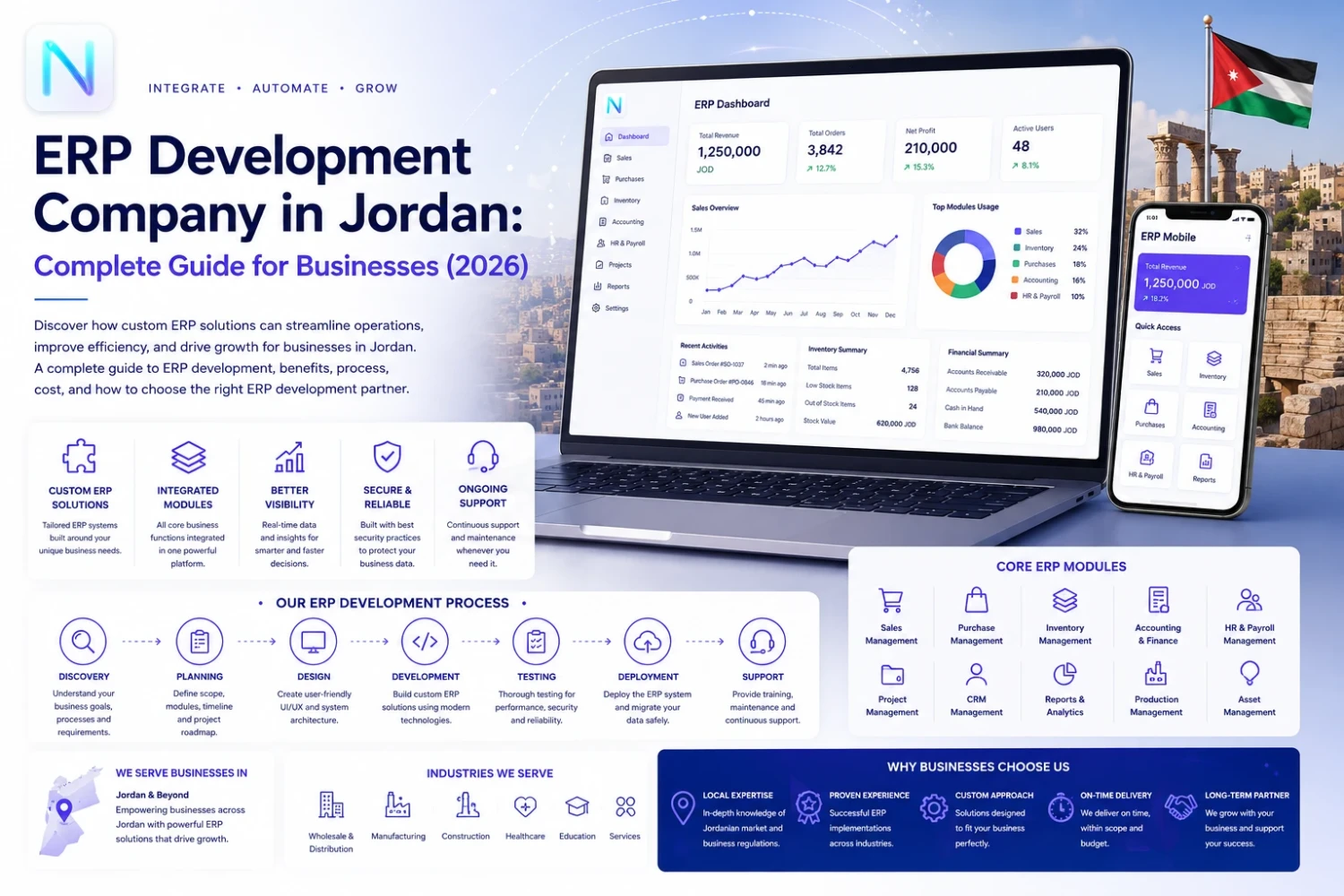
Enterprise Resource Planning (ERP) systems have become the foundation of modern businesses. Companies across Jordan and the GCC are replacing spreadsheets, disconnected software, and manual processes with centralized ERP platforms that improve efficiency, automate workflows, and provide real-time business insights.
Whether you operate a manufacturing company, logistics business, healthcare organization, retail chain, educational institution, construction company, or service provider, an ERP system enables every department to work from a single source of truth.
Choosing the right ERP development company in Jordan is one of the most important technology decisions your business will make. A successful implementation depends not only on software features but also on process design, integration, data quality, training, and long-term support.
This guide explains everything businesses need to know before investing in a custom ERP system.
What is ERP?
Enterprise Resource Planning (ERP) is a centralized software platform that integrates all business departments into one system.
Instead of using multiple disconnected applications, ERP allows businesses to manage:
- Finance
- Accounting
- Sales
- CRM
- Procurement
- Inventory
- Warehouse
- Manufacturing
- Human Resources
- Payroll
- Projects
- Assets
- Customer Service
- Reporting
Every department shares the same database, eliminating duplicate data and improving decision-making.
Why Businesses in Jordan Are Investing in ERP
Jordanian companies are rapidly adopting ERP systems because competition is increasing while customers expect faster service and better accuracy.
Common business challenges include:
- Manual paperwork
- Excel spreadsheets
- Duplicate data
- Inventory mistakes
- Delayed financial reports
- Poor communication
- Lack of visibility
- Slow approvals
- Human errors
- Difficult auditing
An ERP system solves these problems by automating daily operations and providing real-time information across the organization. ERP adoption in Jordan continues to grow alongside broader digital transformation initiatives.
Benefits of Custom ERP Development
A custom ERP system is designed specifically around your company's workflow.
Benefits include:
Centralized Data
Everyone works from one database.
Better Productivity
Employees spend less time on repetitive work.
Automated Workflows
Approvals, notifications and tasks happen automatically.
Real-Time Reports
Management always has accurate dashboards.
Improved Customer Service
Sales, support and operations work together.
Higher Security
Role-based permissions protect company information.
Business Scalability
ERP grows with your organization.
ERP Modules
A modern ERP platform usually includes:
Accounting
- General Ledger
- Accounts Payable
- Accounts Receivable
- Bank Reconciliation
- Financial Statements
Human Resources
- Employee Records
- Payroll
- Leave Management
- Attendance
- Performance
Inventory Management
- Stock Control
- Warehouses
- Transfers
- Barcode Support
- Batch Tracking
Procurement
- Purchase Requests
- Purchase Orders
- Vendor Management
- Supplier Evaluation
Sales
- Quotations
- Orders
- Invoices
- Customer Management
CRM
- Leads
- Opportunities
- Sales Pipeline
- Activities
Manufacturing
- Production Orders
- Bill of Materials
- Work Orders
- Machine Planning
Project Management
- Tasks
- Timesheets
- Budgets
- Resources
Asset Management
- Equipment
- Maintenance
- Depreciation
Reports & Dashboards
- Executive Dashboard
- Financial KPIs
- Sales Analytics
- Inventory Reports
Industries That Benefit from ERP
ERP systems are suitable for:
- Manufacturing
- Logistics
- Healthcare
- Construction
- Retail
- Wholesale
- Education
- Government
- Hospitality
- Food & Beverage
- Automotive
- Real Estate
- Professional Services
Cloud ERP vs On-Premise ERP
Cloud ERP
Advantages
- Lower infrastructure cost
- Remote access
- Automatic updates
- High availability
- Faster deployment
On-Premise ERP
Advantages
- Full infrastructure control
- Internal hosting
- Custom security policies
Many businesses in the Middle East are increasingly moving toward cloud-native or hybrid ERP deployments because of scalability and easier integration.
ERP Development Process
A professional ERP project typically follows these phases:
1. Business Analysis
Understand business processes.
2. System Design
Create architecture and workflows.
3. UI/UX Design
Design intuitive interfaces.
4. Development
Build ERP modules.
5. Integration
Connect payment gateways, accounting systems, CRM, HR, POS, e-commerce, and third-party APIs.
6. Testing
Functional, security and performance testing.
7. Data Migration
Import existing company data.
8. User Training
Train employees.
9. Go Live
Launch production system.
10. Ongoing Support
Maintenance and improvements.
Technologies Used
Modern ERP systems commonly use:
Backend
- Laravel
- .NET
- Node.js
- Java
Frontend
- Vue.js
- React
- Angular
Database
- PostgreSQL
- MySQL
- SQL Server
Cloud
- AWS
- Azure
- Google Cloud
Mobile
- Flutter
- React Native
ERP Integrations
An ERP platform can integrate with:
- CRM
- Accounting Software
- Banking APIs
- Payment Gateways
- WhatsApp Business
- SMS
- POS Systems
- HR Systems
- Government APIs
- Shipping Companies
- E-commerce Platforms
ERP Security
Security features include:
- Multi-factor Authentication
- Encryption
- Audit Logs
- Role Permissions
- Activity Tracking
- Data Backup
- Disaster Recovery
- Secure APIs
Security and compliance remain top priorities for ERP deployments as cyber threats and regulatory requirements increase.
ERP Implementation Challenges
Common challenges include:
- Poor planning
- Dirty data
- Lack of training
- Scope changes
- Weak project management
- Low employee adoption
- Choosing the wrong implementation partner
Industry practitioners consistently emphasize that ERP projects succeed when organizations improve business processes instead of simply digitizing existing inefficiencies.
ERP Cost in Jordan
ERP pricing depends on:
- Number of users
- Modules
- Integrations
- Mobile Apps
- Reports
- Workflow Complexity
- Cloud Infrastructure
- Custom Features
There is no fixed price because every company has different requirements.
Future ERP Trends (2026)
Businesses are increasingly adopting:
- AI-powered reporting
- Predictive analytics
- Workflow automation
- Low-code customization
- Cloud ERP
- Mobile ERP
- API-first architecture
- Real-time dashboards
- Multi-company management
- Business Intelligence
These trends are shaping ERP investments in 2026, particularly around AI, composable architectures, and cloud adoption.
Why Choose Neion Tech?
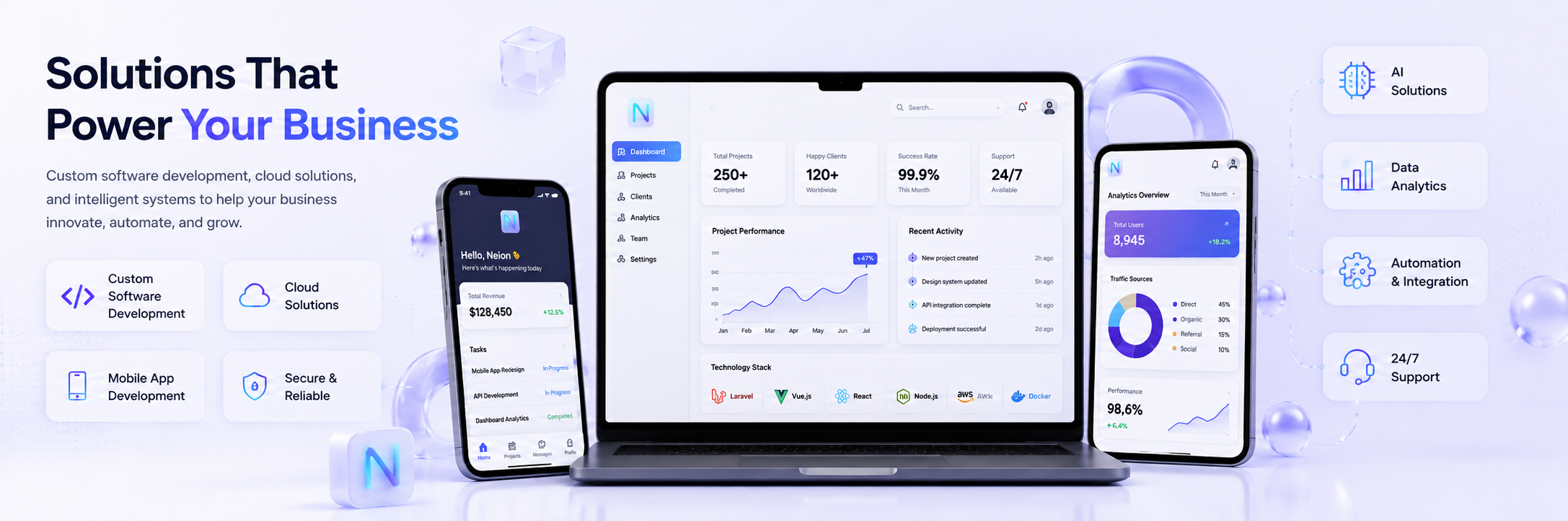
Neion Tech develops custom ERP solutions for businesses across Jordan and GCC countries.
Services include:
- ERP Consulting
- Business Analysis
- Custom ERP Development
- ERP Modernization
- Mobile ERP Applications
- API Integration
- Cloud Deployment
- ERP Support & Maintenance
Our solutions are designed around your business processes, ensuring scalability, security, and long-term growth.
Frequently Asked Questions
What is ERP?
ERP is software that integrates all business operations into one centralized platform.
How long does ERP development take?
Most projects require between 3 and 12 months depending on complexity.
Is custom ERP better than ready-made ERP?
If your business has unique workflows or requires integrations, custom ERP provides greater flexibility and long-term value.
Can ERP integrate with existing software?
Yes. Modern ERP systems integrate with accounting software, CRMs, payment gateways, POS systems, HR platforms, e-commerce solutions, and external APIs.
Is ERP suitable for small businesses?
Yes. ERP can be implemented gradually, allowing SMEs to start with essential modules and expand as they grow.
Does ERP work on mobile devices?
Yes. Modern ERP platforms provide responsive web interfaces and native mobile applications for Android and iOS.
Conclusion
A modern ERP system is more than business software—it is the digital backbone of an organization. By integrating finance, HR, inventory, sales, procurement, manufacturing, and reporting into one secure platform, companies gain better visibility, automate operations, and make faster, data-driven decisions.
If your business is planning digital transformation in 2026, partnering with an experienced ERP development company in Jordan can help you build a scalable solution that supports growth across Jordan and the GCC while adapting to future business needs.
Leave a comments:
Comments: