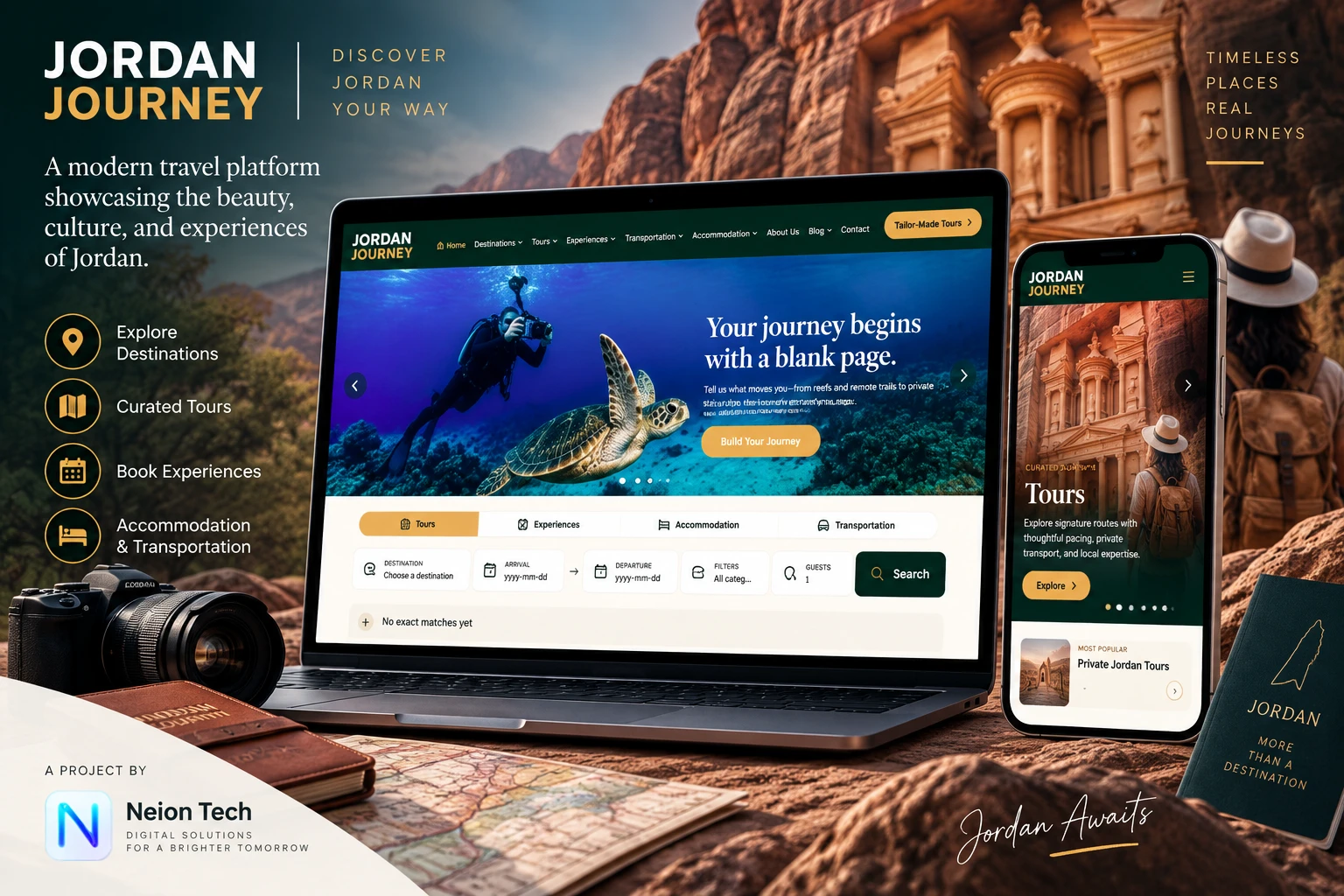
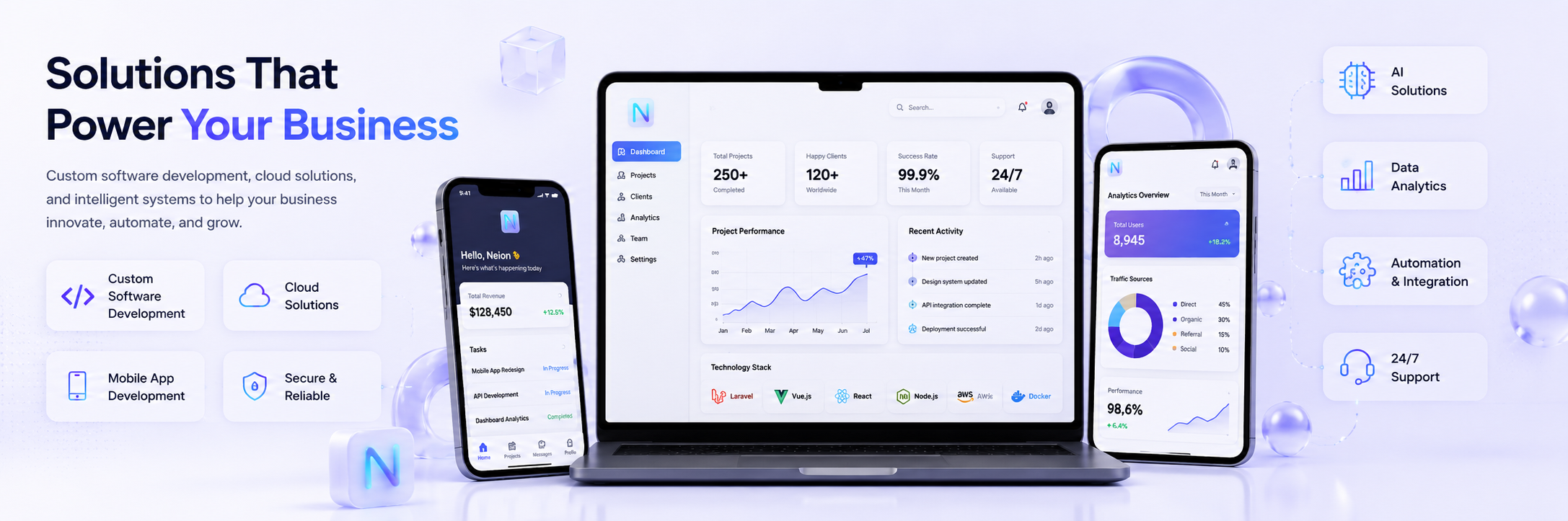
Neion Tech builds business websites and web applications for companies in Jordan and the GCC. We plan the pages, visitor journeys, content management and integrations your project needs. Whether the goal is presenting your services, receiving booking requests or supporting account-based workflows, the proposal defines the work and handover responsibilities.
Start with what visitors need to find or complete
A useful website helps a visitor understand your business and take the right next step. Define the pages, information and actions that support that goal before deciding on the implementation.
The requirements change when a project moves beyond public content into user accounts, records, approvals or payment. Separate these needs early so the quotation covers the product you actually expect.
Compare three website scopes
A corporate service website
Present the company, services, selected work and contact paths. Define the page structure, Arabic/English content, editing tools, forms and what the team can manage after handover.
A booking-request website
Visitors explore services and send a request for staff review. Define required information, validation, storage, notifications and follow-up. Instant availability, confirmed reservations and online payment are additional workflows to evaluate separately.
A customer portal or web application
Users sign in and complete tasks while staff manage records and permissions. Define data ownership, role access, status changes, reporting and external connections alongside the public pages.
These examples are scope comparisons, not fixed packages or automatic feature inclusions.
What your website project can deliver
| Deliverable |
What to confirm in the proposal |
| Structure and design |
Page inventory, navigation, page templates, mobile layouts and review responsibilities |
| Content management |
Editable content, administrator roles, media handling and language responsibilities |
| Forms and enquiry journeys |
Fields, validation, storage, notifications, confirmation and staff handling |
| Application features |
Accounts, permissions, records and integrations where required |
| Existing-site migration |
URLs/content to preserve, data migration and redirect responsibilities |
| Technical preparation |
Agreed metadata, canonicals, language links, sitemap and performance/accessibility checks |
| Launch and handover |
Domain/hosting access, deployment, content guidance and ongoing responsibilities |
Ask which deliverables are included and who supplies the copy, translations, photographs, branding and approvals. This prevents content work from becoming an unresolved dependency near launch.
Make the enquiry journey part of acceptance
A working form is more than a visible submit button. Agree the required fields, validation messages, successful storage, staff notification and confirmation shown to the visitor. Decide how failed notifications are detected or followed up where that is part of the agreed workflow.
For a replacement website, review existing URLs and important content before launch. The migration plan should identify what stays, what moves and which redirects are needed. Changing a design does not by itself require changing established URLs.
Choose the platform for the management and workflow needs
A content-managed company website and a custom account-based application have different maintenance and development needs. WordPress may fit an editorial or service website; a custom application may fit specialised roles and workflows. The implementation choice should follow the requirements and the team's management needs.
Define Arabic/English editing, forms, external services and future changes before selecting an approach. Where payments or other integrations are needed, review provider documentation and account access rather than assuming every method is available.
Understand website cost and delivery stages
The estimate depends on page types, content readiness, languages, design, management tools, forms, integrations and migration. A content website with agreed templates has a different scope from a portal with accounts and operational records.
Plan timing around content/page approval, design review, development, functional checks and launch preparation. Identify when your team provides translations, assets and access, and when external dependencies need approval.
Separate initial development from content creation, hosting, maintenance, licences and provider charges where applicable. Clarify how additional pages, templates, workflows or integrations after scope agreement are estimated.
Agree access, ownership and support
Before launch, identify who controls the domain, hosting and administrative accounts, which code/design/content assets are handed over, and any third-party licence restrictions. Confirm how the authorised owner can regain access or move the site if circumstances change.
The agreement should distinguish defect correction from content updates, platform updates, backups, monitoring and new development. Define coverage, period and recurring fees for the support arrangement you choose.
Prepare your website brief
Share your current URL if one exists, intended audience, required pages and the main action visitors should complete. Include languages, available content, editing needs, integrations and preferred launch window.
If the project may combine a website, mobile app and internal system, use our development service guide. For language, operational and handover planning for local users, read planning a software project for Jordan.
Frequently asked questions
A website can explain services and receive enquiries. A web application supports defined tasks using accounts, data and workflows. Some projects combine both; identify the actions and administration required before choosing the implementation.
Content editing can be included in the scope. Specify the pages, fields, media and language versions your team needs to manage, along with administrator roles and handover guidance.
Start with an inventory of existing URLs, content and functions. The migration scope should identify what is preserved, moved or redirected and how the changes are checked before release.
Not necessarily. A request form sends information for review. Confirmed availability, payment and reservation creation require their own defined rules and integrations.
Agreed technical SEO and useful content can support search visibility, but development does not guarantee rankings or traffic. Search performance depends on the wider content, competition and search environment.
Discuss your website project
Share the pages, content, management needs and visitor actions you want to support. Discuss your website project with Neion Tech so we can review the requirements and prepare an appropriate scope.
Independent reviews
Neion Tech on Clutch
Explore Neion Tech’s Clutch profile for company information and reviews available on the platform.
View Neion Tech on Clutch
Ratings reflect published Clutch client feedback when displayed, not every project we deliver. We welcome honest reviews after completed engagements.