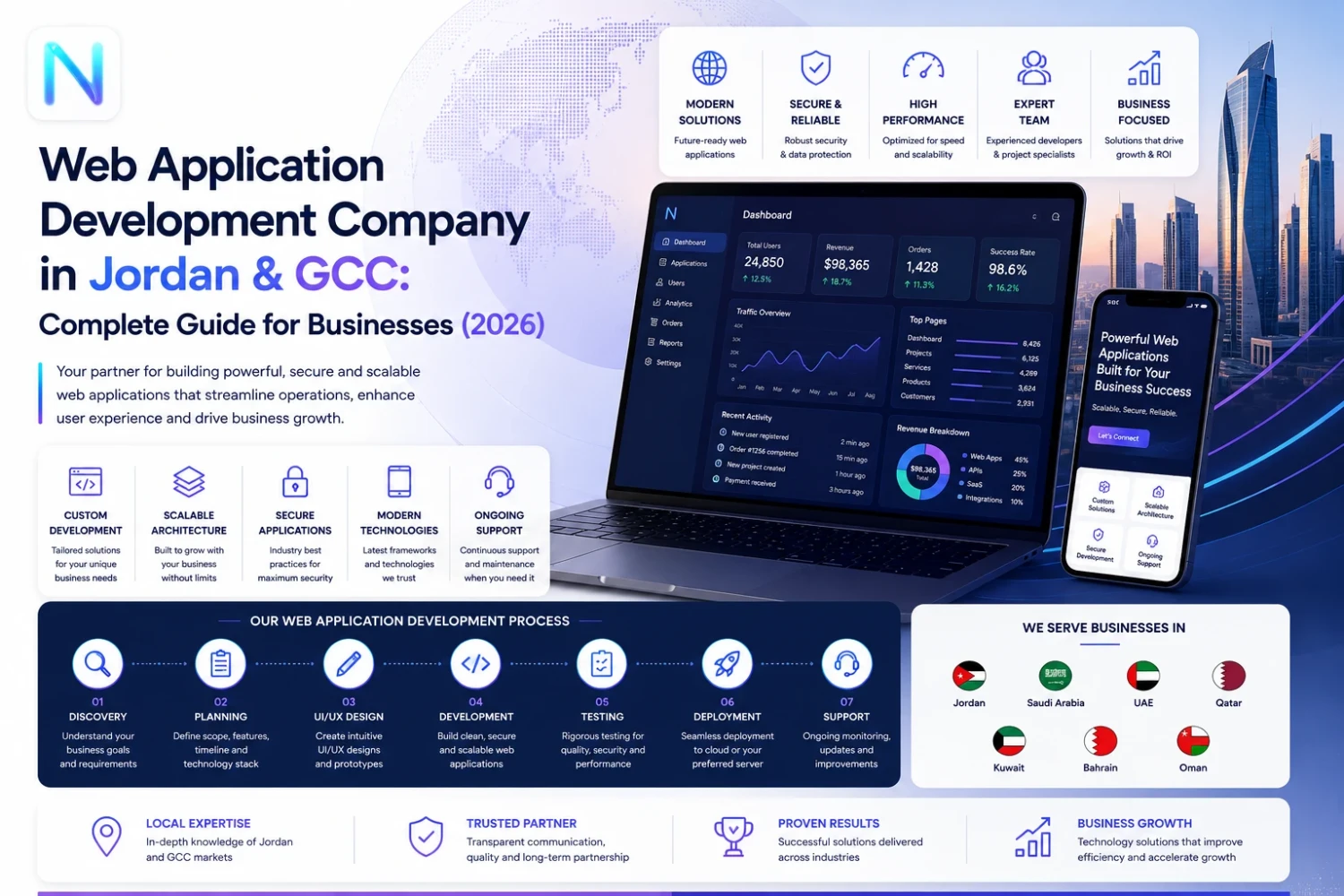
Digital transformation has become a strategic priority for businesses across Jordan and the Gulf Cooperation Council region. Companies in Saudi Arabia, the United Arab Emirates, Qatar, Kuwait, Bahrain, and Oman are increasingly replacing spreadsheets, manual processes, and disconnected software with custom web applications that improve efficiency, automate workflows, and deliver better customer experiences.
A professionally developed web application can become the central platform through which a business manages employees, customers, sales, inventory, finances, bookings, operations, and reports. Unlike a basic website that mainly displays information, a web application enables users to perform tasks, access data, communicate with teams, and manage business operations through an interactive online system.
Whether you are a startup building a new digital product, an enterprise modernizing outdated systems, or a growing company seeking better operational efficiency, choosing the right web application development company can significantly influence the success of your project.
This complete guide explains everything businesses need to know about web application development in Jordan and GCC countries, including its benefits, available solutions, development technologies, project costs, implementation stages, and how to choose the right software development partner.
What Is Web Application Development?
Web application development is the process of designing, building, testing, deploying, and maintaining interactive software that users access through a web browser.
Unlike traditional desktop software, web applications usually do not require users to install a separate program on every device. Employees, customers, managers, suppliers, and business partners can access the system securely through desktop computers, tablets, or mobile devices.
A web application can be developed for internal business operations, customer-facing services, subscription-based software products, or communication between different departments and external platforms.
Examples of modern web applications include:
- Business management systems
- SaaS platforms
- Enterprise portals
- Customer relationship management systems
- Enterprise resource planning systems
- Employee portals
- Customer dashboards
- Booking and reservation platforms
- E-commerce management systems
- Online marketplaces
- Logistics management platforms
- Healthcare management systems
- Financial dashboards
- Inventory systems
- Vendor and supplier portals
Custom web applications are designed around the actual workflows, goals, users, and requirements of a specific business. This gives companies greater flexibility than using generic ready-made software that may include unnecessary features or lack essential functionality.
Website vs Web Application
A corporate website is primarily designed to present information about a company, including its services, projects, team, contact details, and business background.
A web application provides interactive functionality. Users can log in, submit information, manage records, complete transactions, monitor activities, generate reports, communicate with others, and access personalized dashboards.
For example, a logistics company website may explain shipping services and allow potential clients to submit inquiries. A logistics web application may allow customers to track shipments, manage orders, download documents, review invoices, and communicate with the operations team.
Many businesses need both solutions: a professional corporate website for marketing and lead generation, and a secure web application for customers, employees, or business operations.
Why Businesses in Jordan and GCC Are Investing in Custom Web Applications
Businesses across Jordan and GCC countries are operating in increasingly competitive and technology-driven markets. Customers expect faster services, employees need efficient tools, and management teams require accurate real-time data to make informed decisions.
Custom web applications help companies respond to these expectations by creating a centralized digital environment for managing business processes.
Digital Transformation in Jordan
Jordan has developed a strong technology sector supported by skilled software engineers, entrepreneurs, digital service providers, and technology-focused educational institutions.
Businesses in Jordan are adopting web applications to modernize internal processes, reduce paperwork, improve customer communication, and expand their services online.
Startups are also using custom web applications to build SaaS platforms, marketplaces, booking services, financial products, educational systems, and other digital business models.
Saudi Arabia and Vision 2030
Saudi Arabia continues to invest heavily in digital transformation as part of Vision 2030. Businesses in sectors such as retail, healthcare, logistics, tourism, finance, real estate, education, and government services are adopting modern digital platforms.
Custom web applications allow Saudi companies to automate operations, support Arabic and English users, manage large volumes of data, and provide digital services that align with the expectations of the local market.
Jordan-based software companies can support Saudi businesses by providing regional understanding, compatible working hours, bilingual communication, and cost-effective technical expertise.
Digital Growth in the UAE
The United Arab Emirates is one of the region’s most advanced digital markets. Companies in Dubai, Abu Dhabi, Sharjah, and other emirates regularly invest in cloud platforms, enterprise software, artificial intelligence, e-commerce systems, and mobile applications.
A scalable web application can help UAE businesses introduce new services, improve operational visibility, connect multiple branches, and serve customers across different countries.
Technology Adoption in Qatar, Kuwait, Bahrain, and Oman
Businesses in Qatar, Kuwait, Bahrain, and Oman are also modernizing their processes through cloud computing, online customer services, automation, data analytics, and integrated business systems.
The growing demand for secure and scalable digital platforms creates significant opportunities for businesses that invest in custom web application development.
Benefits of Custom Web Application Development
A custom web application is developed specifically for the needs of a business. It can therefore provide greater flexibility, efficiency, and long-term value than generic software.
Business Process Automation
Many companies still depend on repetitive manual tasks such as copying information between spreadsheets, preparing reports, sending reminders, updating records, and following up with customers.
A custom web application can automate these processes. For example, the system can automatically create invoices, send notifications, update order statuses, assign tasks, generate reports, and synchronize information with external platforms.
Automation reduces the workload on employees and allows teams to focus on more important activities.
Improved Operational Efficiency
When departments use separate tools and documents, employees may spend significant time searching for information or verifying which version is correct.
A centralized web application gives authorized users access to the same updated information. This improves collaboration between departments and reduces delays caused by fragmented systems.
Centralized Data Management
Custom web applications can store customer records, orders, payments, products, documents, employee information, and operational data in one organized system.
Centralized data management helps businesses avoid duplicate records, improve data accuracy, and maintain better control over sensitive information.
Better Customer Experience
Customers increasingly expect convenient digital services. They want to submit requests, monitor progress, review information, and receive support without making repeated phone calls.
A customer-facing web application can provide personalized dashboards, order tracking, online payments, downloadable documents, appointment scheduling, notifications, and support requests.
A better customer experience can improve satisfaction, loyalty, and brand reputation.
Enhanced Security
Security can be planned according to the specific risks and requirements of the business.
A professionally developed system may include:
- Secure authentication
- Role-based permissions
- Data encryption
- Activity logging
- Secure API connections
- Automated backups
- Session management
- Protection against common web vulnerabilities
- Multi-factor authentication
- Controlled access to sensitive records
Security should be considered throughout the entire development process rather than added only after the application has been completed.
Scalable Infrastructure
A custom application can be designed to support future growth. The architecture may allow the business to add more users, branches, services, integrations, languages, and features without rebuilding the entire platform.
Scalability is especially important for startups, SaaS products, marketplaces, and companies planning regional expansion.
Cloud Accessibility
Cloud-based web applications can be accessed securely from different offices, cities, and countries. This is particularly valuable for companies operating across Jordan, Saudi Arabia, the UAE, and other GCC markets.
Managers can monitor performance while travelling, employees can work from multiple locations, and customers can access services at any time.
Easy Third-Party Integrations
Modern businesses often need their systems to connect with other platforms.
A custom web application can integrate with:
- Payment gateways
- Accounting software
- Customer relationship management platforms
- Shipping providers
- SMS gateways
- Email services
- Cloud storage
- Google Maps
- Social media platforms
- Government services
- Identity verification services
- Enterprise resource planning systems
Integrations reduce manual data entry and create a smoother flow of information between systems.
Better Reporting and Analytics
Management teams need reliable information to understand business performance.
A custom application can provide dashboards and reports showing sales, revenue, expenses, customer activity, inventory levels, employee productivity, order status, and other important indicators.
Reports can be filtered by date, branch, department, service, customer, or region, giving decision-makers a clearer view of operations.
Lower Long-Term Costs
Custom development may require a larger initial investment than subscribing to basic software. However, it can reduce long-term costs by eliminating unnecessary subscriptions, manual work, duplicated systems, and expensive operational errors.
The business also gains greater control over the platform and can improve it according to future requirements.
Types of Web Applications We Develop
At Neion Tech, web applications are planned around the goals, workflows, and users of each business.
Enterprise Software
Enterprise web applications help large organizations manage complex operations, departments, locations, employees, and approval processes through a centralized platform.
CRM Systems
Custom CRM systems help businesses manage leads, customers, communications, sales opportunities, follow-ups, proposals, and customer support activities.
ERP Solutions
ERP platforms connect important business functions such as finance, inventory, purchasing, sales, human resources, and operations in a single system.
Logistics Platforms
Logistics web applications can support shipment management, order processing, fleet operations, documentation, warehouse activities, customer communication, and operational reporting.
Healthcare Systems
Healthcare applications may include patient records, appointment scheduling, clinic administration, doctor dashboards, billing, notifications, and secure document management.
School and Education Management Systems
Educational platforms can manage students, teachers, courses, attendance, examinations, payments, schedules, and communication with parents.
Human Resources Systems
HR applications help companies manage employee records, attendance, leave requests, payroll information, evaluations, recruitment, documents, and internal approvals.
Booking and Reservation Platforms
Booking systems can be developed for clinics, hotels, restaurants, transportation companies, consultants, training centers, and service providers.
E-commerce Platforms
Custom e-commerce systems provide greater flexibility than standard templates. Businesses can implement specialized product structures, delivery rules, payment options, pricing models, and integrations.
Marketplace Platforms
A marketplace connects multiple sellers or service providers with customers. These systems may include vendor accounts, commissions, payments, reviews, order management, and administrative dashboards.
Financial Systems
Financial web applications can support invoicing, payments, transaction records, expense management, account reconciliation, reporting, and approval workflows.
Real Estate Platforms
Real estate applications may manage properties, agents, customers, inquiries, contracts, appointments, payments, and property listings.
Government and Public-Service Portals
Public-service portals can digitize applications, requests, document submissions, approvals, notifications, and communication between citizens and institutions.
Customer Portals
A customer portal gives each client secure access to relevant services, documents, orders, invoices, account details, and support requests.
Vendor Portals
Vendor portals help businesses manage supplier registration, purchase requests, quotations, contracts, invoices, documents, and approval processes.
Industries That Benefit from Web Application Development
Custom web applications can support organizations across almost every sector.
Neion Tech develops digital solutions for businesses and institutions in industries such as:
- Healthcare
- Construction
- Education
- Retail
- Manufacturing
- Hospitality
- Finance
- Insurance
- Transportation
- Logistics
- Government services
- Real estate
- Oil and gas
- Telecommunications
- Professional services
- E-commerce
- Tourism
- Startups
- Small and medium-sized businesses
- Large enterprises
The correct solution depends on the organization’s workflows, users, security needs, integrations, and long-term objectives.
Technologies Used for Modern Web Application Development
Selecting the right technology stack is an important part of building a secure, scalable, and maintainable web application.
The technology should be chosen according to the project’s requirements rather than simply using the newest available framework.
Backend Development
The backend manages business logic, authentication, permissions, database operations, APIs, notifications, and integrations.
Common backend technologies include:
- Laravel
- PHP
- Node.js
- REST APIs
- GraphQL
Laravel is a powerful choice for building secure business applications, customer portals, SaaS platforms, dashboards, and enterprise systems. It provides a structured architecture and strong tools for authentication, database management, queues, notifications, and API development.
Frontend Development
The frontend is the part of the application that users interact with.
Modern frontend technologies include:
- Vue.js
- React
- Next.js
- JavaScript
- HTML5
- CSS3
Vue.js and React can provide fast, interactive, and responsive interfaces for dashboards, portals, and complex business applications.
Database Technologies
The database stores and organizes application information.
Common database technologies include:
- MySQL
- PostgreSQL
- Redis
The database architecture should support security, performance, data integrity, reporting, and future scalability.
Cloud and DevOps Technologies
Modern web applications are often deployed using cloud and automation technologies such as:
- Amazon Web Services
- Microsoft Azure
- Google Cloud
- Docker
- GitHub
- CI/CD pipelines
- Automated backups
- Monitoring systems
Cloud infrastructure allows businesses to scale resources according to usage and maintain better availability for customers and employees.
Our Web Application Development Process
A successful web application requires more than writing code. It requires planning, communication, testing, and long-term technical decisions.
Discovery
The discovery stage focuses on understanding the business, users, challenges, workflows, competitors, and project goals.
The development team works with stakeholders to identify what the application should achieve and which problems it should solve.
Requirements Planning
The project requirements are organized into modules, features, user roles, integrations, reports, and technical specifications.
Clear requirements help reduce misunderstandings and improve cost and timeline estimates.
UI and UX Design
The UI and UX design stage determines how users will navigate and interact with the application.
Wireframes and interface designs are created for important pages such as login screens, dashboards, forms, reports, profile pages, and administrative panels.
System Architecture
The technical architecture defines how the frontend, backend, database, APIs, cloud infrastructure, and external services will work together.
Good architecture supports security, performance, scalability, and easier future maintenance.
Development
Developers build the system according to the approved requirements and designs.
Large projects are often divided into phases or development sprints. This allows stakeholders to review progress and provide feedback throughout the project.
Quality Assurance and Testing
The application is tested to identify functional, usability, compatibility, performance, and security issues.
Testing may include:
- Feature testing
- Form validation testing
- Permission testing
- API testing
- Mobile responsiveness testing
- Browser compatibility testing
- Performance testing
- Security review
- User acceptance testing
Deployment
After approval, the application is deployed to the production server or cloud environment.
The deployment process may include configuring domains, SSL certificates, databases, backups, monitoring, email services, and external integrations.
Maintenance and Support
After launch, the application may require updates, technical support, security improvements, performance monitoring, and new features.
Long-term support helps keep the platform reliable as the business and technology environment evolve.
Continuous Improvement
A web application should continue to improve based on user feedback, analytics, business growth, and changing market requirements.
New modules and integrations can be added gradually according to business priorities.
Key Features Every Modern Web Application Should Include
The required features vary by project, but most professional web applications should consider the following capabilities.
Responsive Design
The interface should work effectively across desktop computers, tablets, and mobile devices.
Role-Based Permissions
Administrators should be able to control which pages, records, and actions each user can access.
Management Dashboard
Dashboards should present relevant information and important performance indicators in a clear format.
Reports and Analytics
Businesses should be able to create, filter, export, and review operational and financial reports.
API Integration
The application should support secure communication with mobile applications, payment providers, shipping companies, accounting systems, and other external services.
Notifications
Users may receive alerts through email, SMS, push notifications, or notifications inside the platform.
Secure Authentication
Authentication can include password protection, email verification, password recovery, multi-factor authentication, and controlled sessions.
Cloud Backup
Automated backups help protect the business from accidental data loss, technical failures, and security incidents.
Multilingual Support
Businesses operating in Jordan and GCC markets often require Arabic and English interfaces.
Both languages should be considered during the design stage to ensure correct right-to-left and left-to-right layouts.
Performance Optimization
The application should be optimized for fast page loading, efficient database queries, compressed assets, and reliable performance.
Security Controls
Security measures should protect user accounts, personal data, financial information, business records, and system integrations.
Scalability
The system should be capable of supporting future users, branches, services, products, and transaction volumes.
Web Application Development Cost in Jordan and GCC
The cost of developing a web application depends on the size, complexity, features, design, technology, integrations, and security requirements of the project.
A simple internal management system will usually cost less than a large marketplace, enterprise platform, or SaaS product with multiple subscription plans and third-party integrations.
Project Complexity
A platform with several user roles, approval processes, dashboards, and reports requires more planning and development than a basic application.
Number of Features
Each feature requires design, development, testing, and integration with other parts of the system.
Examples include online payments, booking calendars, real-time notifications, file management, inventory control, and advanced analytics.
Third-Party Integrations
Connecting the application with external systems may require additional development, testing, subscriptions, or approval from service providers.
Project Timeline
A short delivery deadline may require a larger development team or a reduced first-phase scope.
Technology Stack
The selected frameworks, hosting environment, databases, and external services can affect the total project cost.
UI and UX Requirements
A custom interface with detailed workflows and advanced interactive elements requires more design and frontend development.
Security and Compliance
Applications handling financial, medical, government, or sensitive customer information may require enhanced security controls and specialized compliance measures.
Cloud Infrastructure
Hosting costs depend on the expected number of users, storage requirements, traffic, backups, and availability needs.
Maintenance and Future Development
Businesses should consider ongoing maintenance, technical support, infrastructure, security updates, and future feature development as part of the long-term budget.
The most reliable way to estimate the cost is to prepare a clear project scope and review it with an experienced software development company.
Why Choose a Jordan-Based Web Development Company for GCC Projects?
Jordan has become an attractive destination for companies seeking high-quality, cost-effective software development services for GCC projects.
Competitive Development Costs
Jordan-based development teams can often provide competitive pricing compared with companies in Europe or North America while maintaining professional engineering and project management standards.
Arabic and English Support
Bilingual communication is essential for many regional projects.
A development company that understands both Arabic and English can create better user interfaces, content structures, notifications, reports, and customer experiences.
Regional Business Understanding
Companies in Jordan understand many of the cultural, operational, and commercial requirements shared across Middle Eastern markets.
This helps reduce communication gaps and allows the development team to create solutions that are more relevant to GCC users.
Compatible Working Hours
Jordan and GCC countries have similar working hours, making meetings, project updates, reviews, and technical support easier to coordinate.
Skilled Technical Talent
Jordan has a strong community of software engineers, designers, project managers, and technology professionals with experience in modern development frameworks and cloud solutions.
Faster Communication
Working with a regional company makes it easier to arrange meetings, explain requirements, review progress, and resolve issues without major time-zone differences.
Long-Term Technical Support
A reliable regional partner can provide ongoing support, maintenance, infrastructure management, and future development after the initial launch.
Experience with GCC Projects
A software company that understands Saudi Arabia, the UAE, Qatar, Kuwait, Bahrain, and Oman can better support regional requirements such as bilingual interfaces, local payment gateways, regional hosting, and market-specific workflows.
Why Choose Neion Tech?
Neion Tech is a software development company in Jordan serving businesses across Jordan, Saudi Arabia, the UAE, Qatar, Kuwait, Bahrain, Oman, and other GCC markets.
We design and develop digital solutions that match the specific goals, workflows, and growth plans of each client.
Our services include:
- Custom software development
- Web application development
- Mobile application development
- SaaS platform development
- Enterprise system development
- API development and integration
- Cloud and DevOps solutions
- UI and UX design
- Database design and optimization
- Software modernization
- Maintenance and technical support
- Performance and security improvements
Our development process focuses on clear communication, scalable architecture, responsive design, secure coding, quality assurance, and long-term business value.
Instead of forcing businesses to change their operations to match generic software, we develop solutions around the way each organization works.
Whether you need a customer portal, internal management system, SaaS platform, marketplace, enterprise application, or complete digital ecosystem, Neion Tech can help transform your idea into a secure and scalable product.
Frequently Asked Questions
What is a web application?
A web application is interactive software that users access through a browser. It allows users to perform tasks such as managing information, submitting requests, completing payments, generating reports, and communicating with other users.
How long does it take to develop a web application?
The development timeline depends on the application’s size and complexity. A smaller application may require several weeks, while a large enterprise system or SaaS platform may require several months and multiple development phases.
How much does web application development cost?
The cost depends on features, design, integrations, user roles, security requirements, cloud infrastructure, and the expected development timeline. A detailed scope is required to provide an accurate estimate.
Which technologies does Neion Tech use?
Depending on project requirements, Neion Tech may use Laravel, PHP, Vue.js, React, Next.js, Node.js, MySQL, PostgreSQL, REST APIs, Docker, AWS, Azure, and other modern technologies.
Can you integrate a new application with our existing systems?
Yes. A custom web application can be integrated with accounting systems, payment gateways, CRM platforms, shipping providers, email services, SMS gateways, and other external platforms when supported APIs are available.
Do you provide maintenance and support?
Yes. Maintenance services can include security updates, technical support, bug fixes, performance monitoring, cloud management, backup monitoring, and future feature development.
Can you build Arabic and English web applications?
Yes. Neion Tech develops multilingual applications with proper support for Arabic right-to-left layouts and English left-to-right layouts.
Do you serve businesses in Saudi Arabia and GCC countries?
Yes. Neion Tech works with startups, SMEs, and enterprises in Jordan, Saudi Arabia, the UAE, Qatar, Kuwait, Bahrain, Oman, and other regional markets.
Can an existing system be upgraded?
Yes. Existing applications can often be redesigned, optimized, migrated to modern technologies, connected with new services, or rebuilt gradually while preserving important business data.
Why should we choose custom software instead of ready-made software?
Custom software is designed around your specific workflows, users, integrations, and business goals. It provides greater flexibility and control, while ready-made software may require your company to adapt its operations to predefined features and limitations.
Conclusion
Businesses across Jordan and GCC countries are accelerating digital transformation through custom web applications that improve efficiency, automate operations, enhance customer service, and support long-term growth.
Whether you are building an enterprise platform, customer portal, SaaS product, marketplace, booking system, or internal business management solution, partnering with an experienced web application development company helps ensure that your platform is secure, scalable, reliable, and tailored to your objectives.
At Neion Tech, we specialize in designing and developing high-performance web applications for startups, SMEs, and enterprises across Jordan, Saudi Arabia, the UAE, Qatar, Kuwait, Bahrain, and Oman.
Our team delivers modern and scalable software solutions that help organizations innovate, streamline operations, improve customer experiences, and remain competitive in a rapidly changing digital market.
Contact Neion Tech to discuss your web application requirements and discover how a custom digital solution can support your business growth.
Leave a comments:

Comments: